Question: Why is it that the city seems to zone most townhouses/condos on busy streets rather than quiet streets? Those of us with families looking for more affordable housing deserve quiet streets too! — from “Happy Returnee”
Answer: I’ve heard this complaint more than once in Vancouver and it was brought to mind forcefully when I visited Los Angeles, of all places, this month. But, much as we like to feel smugly superior to Los Angeles, this historic, working-class city has many areas where you’ll see all kinds of housing mixed together: single family, duplex, fourplex, small apartment, all in a single block.
I’m envious of Chicago, too, which has blocks and blocks of townhouses and, my favourite, fourplexes that are designed to look like grand old mansions, yet are actually four spacious apartments. We stayed in one like this last year — three bedrooms, a dining room — on a quiet street, instead of being relegated to the bus routes. And there were also regular small apartment buildings around.
So what’s with Vancouver? We seem to believe that people who choose density also have to face a truck route or something.
I turned to someone who makes more considered judgments than me, former senior city planner Trish French. Here was her analysis.
I’m going to assume that by “condos” the inquirer means apartment buildings: condominium is actually a form of ownership, not a type of residential development. Almost all townhouses in Vancouver are also in condominium ownership. I am reframing the question as “why is it that the city seems to zone most townhouses/apartments on busy streets?” I’ll come back to townhouses specifically at the end.
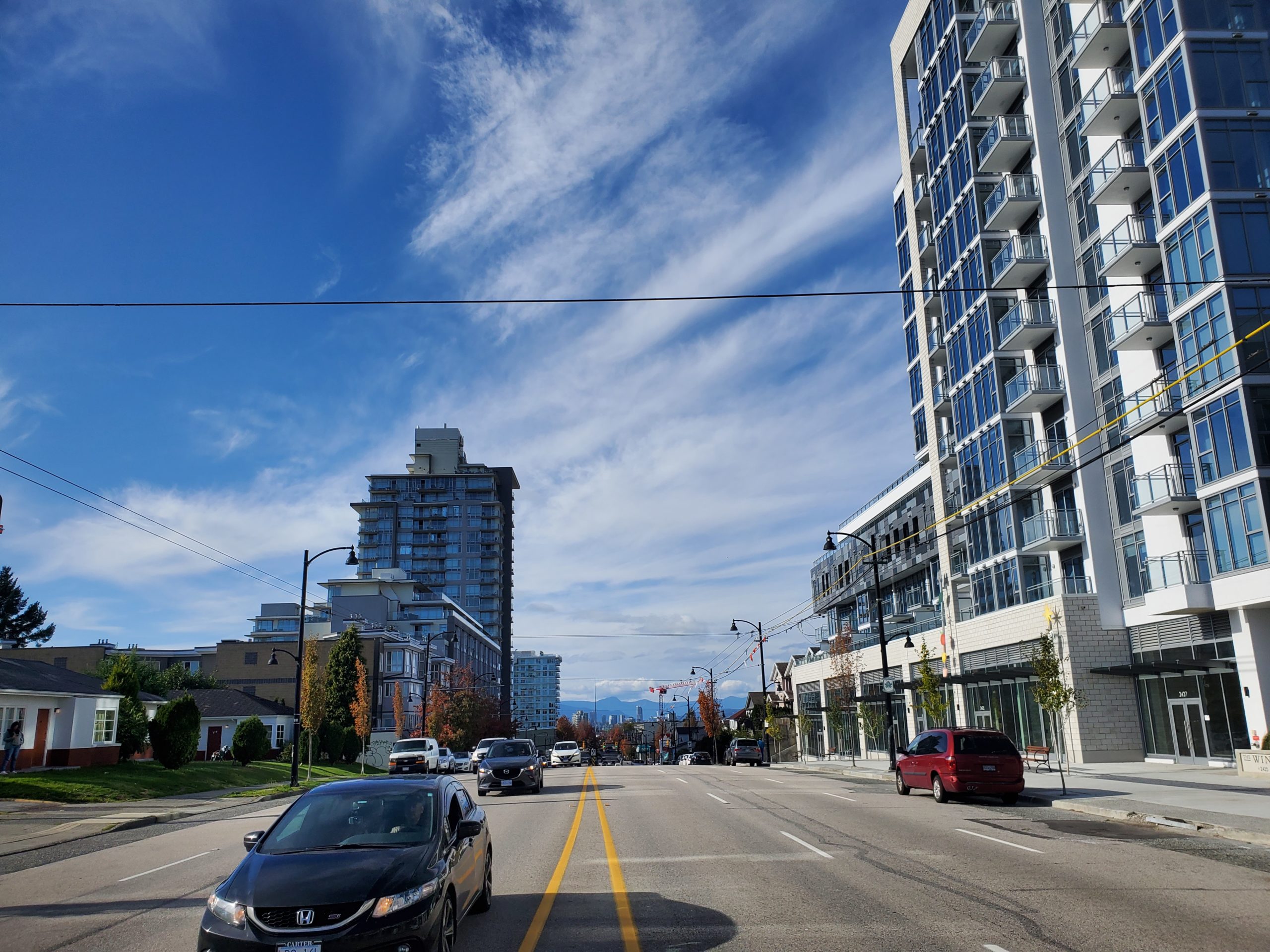
A key word is “seems”, because it isn’t actually the case. About 57% of the City’s housing units are apartments, and 3.3% are townhouses. Most are not on arterials. However, since we tend to travel arterials, we notice the new development there. Nevertheless, the question remains: how does multifamily housing gets to be where it is.
The theoretical explanation goes back to “central place theory” in urban geography and planning, which essentially says that locations with higher levels of accessibility have higher intensity of use, whether commercial, industrial, or residential. This provides an explanation for some early patterns. For example, Vancouver’s West End, Kitsilano, South Granville, and Grandview-Woodland apartment areas were all very accessible to the Downtown commercial core and False Creek industrial areas, where there were many jobs.
However, it is my opinion that since the rise of neighbourhood activism in the late 60’s, the location of rezonings has been most governed by the interplay housing hysteria, developer opportunism, and neighbourhood resident push-back. The housing market is the main spectator sport in the City, and the development community and residents of single family areas are the most important political forces.
So, rather than following any theoretical spatial logic, starting in the 70’s new multi-family zoning began to be approved on anomalous large parcels in single family areas (e.g., Champlain Heights, Langara Estates, Arbutus Village); and on the vacant “brownfield” industrial areas (False Creek, Coal Harbour). While there was still significant local protest, it was less than would have been heard with the rezoning of single family lots within the heart of the neighbourhoods.
In the late 80’s there was another big housing crunch. Still avoiding the heart of single family areas, the City zoned for more residential along commercial (C-2) shopping streets throughout the city, and in underutilized industrial/commercial areas (Arbutus Neighbourhood, Collingwood Village, Commercial/Welwyn area). The Oakridge/Langara area plan also allowed for residential on institutional sites (St. John Ambulance, Peretz school) and some townhouses on Oak St and adjacent to some multifamily sites. More recently, the City has been approving 2nd generation rezonings on some of the large sites that had been first rezoned in the early 70’s. (Champlain Mall, Arbutus Village, Shannon Mews)
However, by the mid 90’s it was obvious that in future, some housing diversity would have to be introduced within single family areas—and in the 1995 CityPlan, the majority of residents agreed. Subsequent resident surveys for the Community Visions done in 9 single family areas confirmed that residents were supportive of low scale forms like townhouses, 4-and 6- plexes, in some locations: around neighbourhood shopping areas; around transit stations; along arterials; and around some parks. They did not want to see townhouses or apartments scattered widely throughout single family areas.
The City’s follow-up on the new housing in the Vision areas has been disappointingly slow. There is townhouse zoning in the Knight and Kingsway neighbourhood centre (the blocks back from Kingsway, between St. Catherine and Commercial ; and townhouse zoning is now being written for the Norquay neighbourhood centre (the blocks back from Kingsway, between Gladstone and Killarney).
The higher profile Cambie Corridor Plan followed up on placing multi-family along the arterial and around transit stations, albeit in a much more aggressive scale than the community residents supported: 6 to 36 storeys, and along the entire corridor rather than just around stations. The next phase of Cambie Corridor planning is supposed to look at townhouses and other lowrise forms in the blocks further back from Cambie Street.
Finally, I also feel—as the questioner seems to –that townhouses would meet the needs of many households. Unfortunately, there is no strong advocate urging the City to take faster action on zoning for townhouses. They aren’t what big developers want to do; the smaller developers who do them don’t pressure Council much; and neighbourhood residents, although more supportive than they were in the past, obviously aren’t advocating for them. Even once townhouse zoning is in place in an area, it is tough to deliver them because sites have to be assembled from individual lots. These days, for a “teardown”, builders who want to build new “single family” can often outbid a builder who wants to do townhouses. This is because of strong demand for single family from affluent buyers, but also because of changes to the single family zones in the past few years. Each single family lot is now allowed 3 units (2 units plus a laneway house) as well as occupiable floor area. These zoning changes had good intentions, but may well have made townhouses uncompetitive economically.