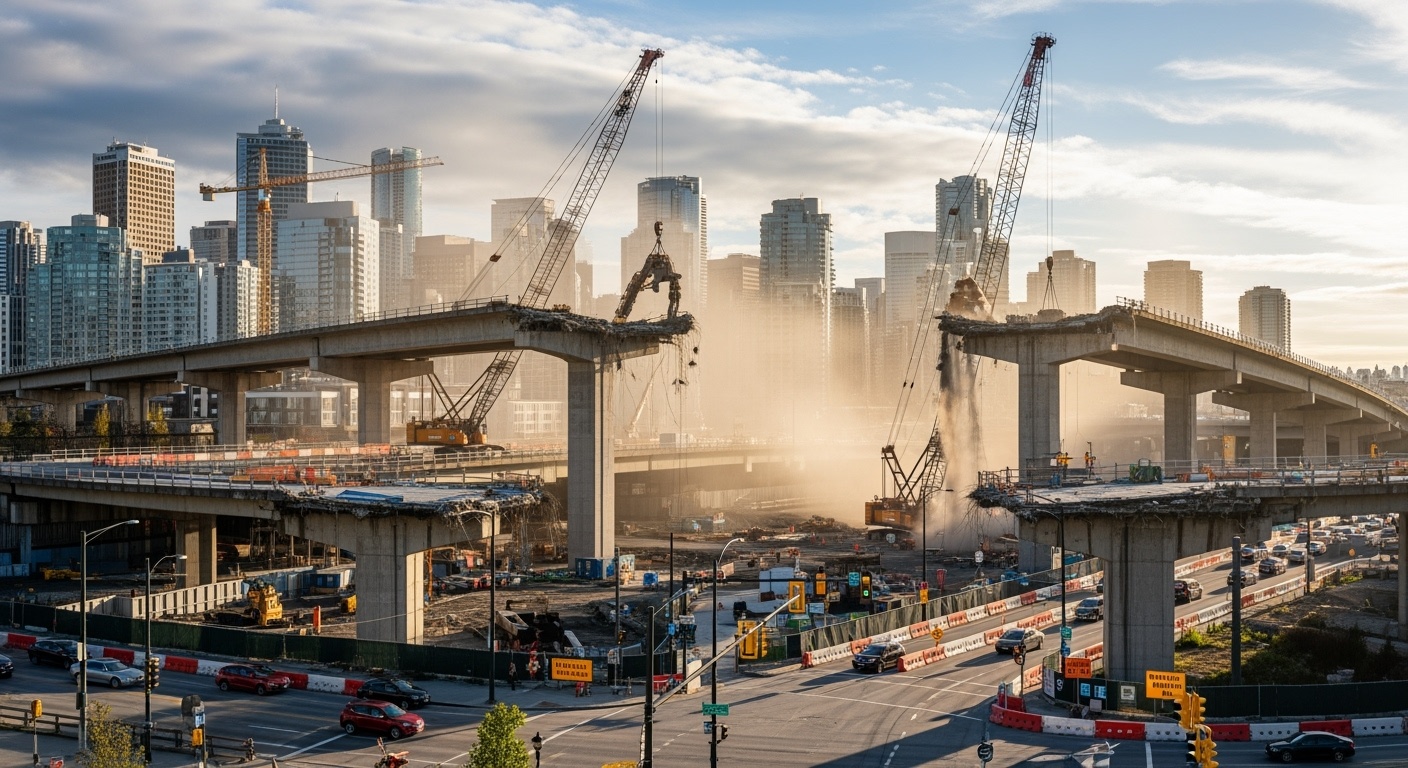
There’s been no official announcement, news release, or staff report yet, but it looks as though the city is headed toward a historic vote on taking the viaducts down, with planners and engineers recommending demolition after having gone out and dug up all the new information council asked for two years ago.
The Georgia and Dunsmuir viaducts, completed in 1972, represent one of Vancouver’s most controversial pieces of infrastructure—concrete monuments to a freeway-building era that the city ultimately rejected. Originally conceived as part of an ambitious 1960s plan by the Vancouver Board of Trade to create a downtown freeway system, the viaducts are the sole survivors of a much larger transportation vision that community opposition killed in 1973.
Now, more than four decades later, the structures that once symbolized progress have become expensive white elephants. The new technical studies commissioned by council paint a stark financial picture: it would cost between $50-65 million just to make the aging viaducts seismically sound enough to survive a moderate earthquake. Even then, they would require an additional $8-10 million in ongoing repairs and maintenance.
As my story in the Globe details, community and business groups are hearing staff presentations that systematically dismantle the case for keeping the viaducts. The engineering analysis reveals structures that are not only costly to maintain but increasingly obsolete in their function. The promised commuter chaos from their removal appears to be largely mythical—new traffic modeling shows that a replacement route connecting Expo Boulevard to a new Georgia Street extension would add only a few minutes to commuter travel times.
The PowerPoint presentation being used at community group talks, which I’m attaching here, doesn’t contain extensive detail but offers several compelling new pieces of information. The seismic studies are particularly damning, showing structures that would be vulnerable in the kind of earthquake Vancouver inevitably faces. The traffic analysis suggests that modern traffic management and alternative routing can handle the displacement more effectively than critics feared.
Perhaps most significantly, the removal opens up extraordinary development opportunities in Northeast False Creek, one of the last large undeveloped areas near downtown Vancouver. The 36-acre site currently sits as an industrial wasteland, cut off from surrounding neighborhoods by the concrete barriers of the viaducts themselves.
The historical irony is unmistakable. The viaducts were built to carry traffic over busy railway yards and industrial land that no longer exist. Today they mainly serve to isolate communities and block potential connections between downtown and the growing residential areas to the east. What once represented the future of urban mobility now stands as an impediment to the kind of walkable, connected neighborhoods that define contemporary city planning.
The political dynamics have shifted dramatically since the viaducts were first questioned. What was once a battle between car-oriented suburbanites and anti-freeway activists has evolved into a more pragmatic discussion about infrastructure costs, seismic safety, and urban redevelopment opportunities.
The community consultations suggest that staff are building consensus for demolition by methodically addressing every technical and financial concern. The message seems clear: keeping the viaducts means spending enormous sums to maintain increasingly obsolete infrastructure, while removing them opens possibilities for creating new neighborhoods and better urban connections.
If council follows the staff recommendations, Vancouver will be taking down some of the most prominent examples of 1970s urban planning still standing in the city—a final rejection of the automobile-dominated vision that briefly captured municipal imagination before community resistance changed the city’s direction forever.