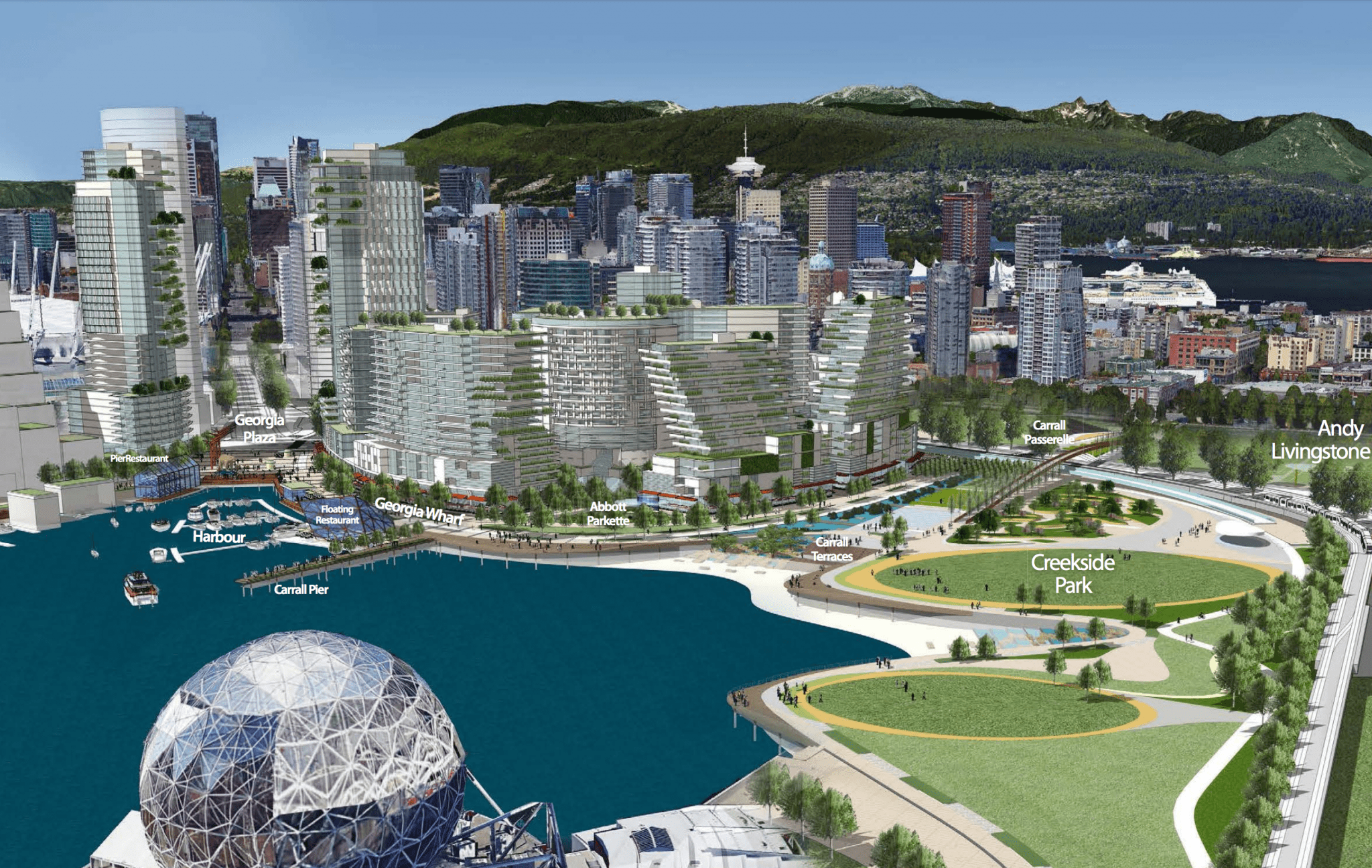
Readers of this blog have been following the debates about the new community to be created at Northeast False Creek for a while. Most MSM haven’t been paying much attention to it yet, likely because it’s just drawings on paper so far.
The Northeast False Creek development represents Vancouver’s most ambitious attempt to integrate residential living with entertainment and commercial uses since False Creek South was developed in the 1970s. Unlike previous developments that have separated residential towers from entertainment districts, this project proposes to weave thousands of homes directly into what planners envision as Vancouver’s premier entertainment destination.
The challenge is unprecedented in Vancouver’s development history. Previous residential developments like Coal Harbour, Yaletown, and the West End have been primarily residential with supporting retail and restaurants. Even downtown’s residential towers exist in a business district that goes quiet after office hours. Northeast False Creek proposes something entirely different: a 24-hour neighborhood where concert venues, sports facilities, and nightlife exist alongside family housing.
The technical complexities alone are staggering. Sound mitigation between entertainment venues and residential units requires sophisticated engineering solutions that go far beyond typical noise bylaws. The traffic management needed to handle both resident parking and event crowds will test Vancouver’s transportation infrastructure. Emergency services will need to develop new protocols for managing crowds while maintaining residential access.
But it’s going to get more public attention in the future, I guarantee. This is an area as big as Coal Harbour, a future home to possibly 7,000 people, and right in the middle of the city. What happens here — or doesn’t — will have impacts beyond the immediate neighbourhood.
The scale and location make this development a potential game-changer for Vancouver’s urban structure. Positioned between downtown and the emerging Olympic Village, Northeast False Creek could either become a vital link connecting different parts of the city or create a barrier that fragments urban flow. The decision to pursue mixed-use development here, rather than maintaining it purely for entertainment or converting it entirely to residential, will establish precedents that influence development decisions across the region for decades.
The economic implications extend far beyond the development itself. Success could demonstrate that high-density residential living is compatible with major entertainment infrastructure, potentially opening other industrial or entertainment areas to similar mixed-use redevelopment. Failure could reinforce the separation of uses that has characterized much of Vancouver’s development, limiting future opportunities for urban innovation.
The social dynamics are equally complex. Creating a neighborhood where families with children live next to concert venues and sports facilities requires rethinking assumptions about urban living. Will parents accept late-night noise and crowds as trade-offs for downtown convenience? Can entertainment venues operate effectively while accommodating residential neighbors’ needs for quiet enjoyment?
International examples offer mixed lessons. London’s South Bank successfully combines residential towers with major cultural venues, but relies on extensive soundproofing and careful event scheduling. Melbourne’s Southbank district integrates apartments with casino and entertainment complexes, though not without ongoing tensions between residents and venue operators.
The Vancouver model’s emphasis on livability and environmental sustainability adds additional complexity. The city’s commitment to green building standards, pedestrian-friendly design, and transit-oriented development must somehow accommodate the parking, loading, and infrastructure needs of major entertainment venues. This tension between sustainability goals and entertainment industry requirements has never been fully resolved in any comparable development.
Here’s my first crack at it in the Globe — 700 words is nowhere near enough to cover all the issues (more like stuffing an octopus into a thimble, I like to say), but it hits the highlights. As I’ve said in previous posts, you can read the full reports on the city’s website (they have a whole section dedicated to NEFC).
The documentation surrounding Northeast False Creek reveals the complexity of questions that planning documents rarely address directly. How do you design public spaces that work for both children’s play and adult entertainment? What happens to property values when concert venues operate next door? How do you maintain neighborhood character when that neighborhood includes major sports facilities?
The timing of these decisions, coming during Vancouver’s Olympic preparations, adds both opportunity and pressure. The global attention focused on Vancouver during the Games could showcase innovative urban design or highlight planning failures on an international stage.